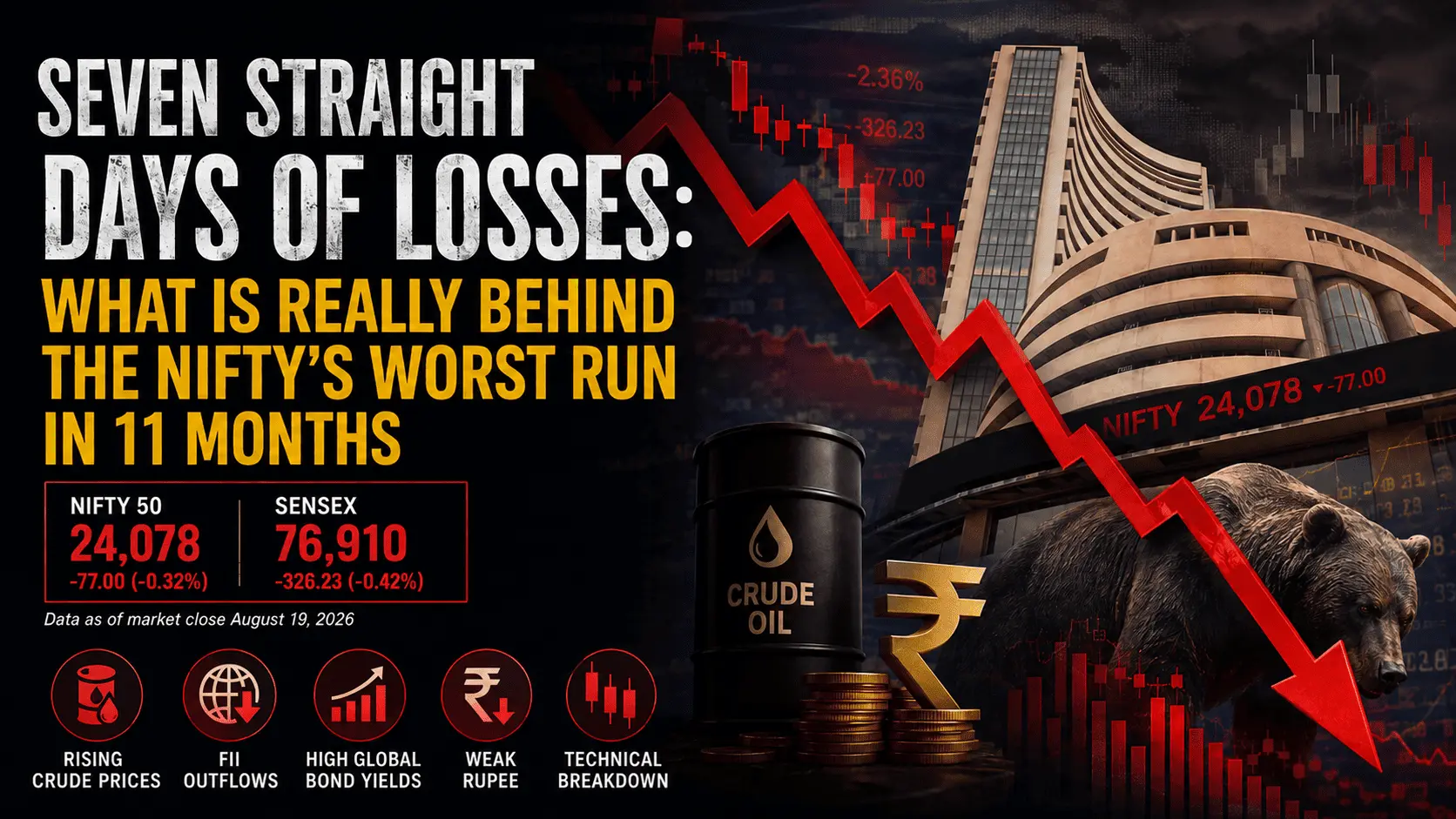
Seven days of pain, then a bounce: what really drove the Nifty’s worst week in 11 months
The Nifty 50 just lived through its worst week in 11 months. For seven straight sessions ending August 19, it fell without a break, shedding 2.1 percent and wiping out roughly Rs 3.2 lakh crore of investor wealth. Then, on August 20, it snapped the streak with a 154-point bounce to 24,232. As of August 21, the market is flat and staring at a familiar enemy: crude oil back above $93. If you are wondering what just hit your portfolio and whether the relief is real, here is the straight story, without the jargon and without the panic.
The week that broke the streak
On August 19, the Nifty closed at 24,078.30, down 76.60 points or 0.32 percent, its seventh consecutive fall. The Sensex dropped 325.78 points to 76,909.68. Across the seven sessions the index lost 2.1 percent, its longest run of daily losses since September 2025. That is the setup. The bounce came the very next day, but to understand whether it holds, you have to understand what caused the fall in the first place.
1. Crude oil was the spark, and it is still burning
Brent crude was around $80 three weeks ago. By August 19 it had climbed to $91.62. On August 20 it jumped another 2.67 percent to $93.91, and on August 21 it sits near $93.4. India imports 85 percent of its oil. When crude rises, India pays more for imports, the trade deficit widens, the rupee weakens, inflation creeps up, and corporate margins shrink. Every link in that chain showed up in the market. The trigger was geopolitical: the US-Iran ceasefire expired with no replacement, Iran adopted a “fully offensive” posture, and Trump threatened an economic war on nations trading with Iran. The Strait of Hormuz, through which one-fifth of the world’s oil flows, remains a flashpoint.
2. Foreign money walked out the door
Foreign institutional investors have pulled a net $25 billion out of Indian equities in 2026, a record for any calendar year, and we are only in August. The math is simple: US government bonds now yield 4.8 to 5.0 percent with zero currency risk. A fund manager in New York can earn 5 percent in Treasuries without worrying about the rupee dropping 3 percent. Why take the risk in Indian stocks? On August 20, even as the market bounced, FIIs turned net sellers again, offloading Rs 583 crore. Domestic institutions absorbed the hit, with DIIs buying Rs 3,538 crore.
3. Global bond yields hit 2007 levels, then something changed
The US 30-year Treasury yield hit its highest in nearly 20 years. So did long-term yields in Germany and Japan. When government bonds across the developed world offer 4 to 5 percent, money leaves emerging markets and flows into those bonds. Higher yields also raise the discount rate on future corporate earnings, which compresses stock valuations, and the Nifty is full of growth stocks. This is the exact force that reversed on August 20: the US Treasury stepped in to contain the surge in bond yields, which dragged the dollar down and revived appetite for emerging-market equities. The relief was real, but analysts warn it may be short-lived as yields climb again.
4. The rupee weakened and the RBI got trapped
The rupee closed at 95.68 against the dollar on August 18, near a three-week low. The RBI has been selling dollars to defend it, draining Rs 3.9 lakh crore from the banking system, the highest liquidity withdrawal on record. The trap is ugly: cut rates to support growth and the rupee falls further; hold rates to defend the rupee and there is no policy support for equities. At $93 crude, the rate-cut thesis that supported bank stocks all year is dead for at least two more quarters.
5. Technical damage triggered a cascade
The Nifty broke below every major moving average, the 20, 40, 100, and 200-day EMAs, and closed below the 50-day simple average for the first time in months. When that many levels break at once, algorithmic systems start selling automatically. Stop-losses at 24,200 and 24,100 triggered one after another, each broken level pulling the next down. It is a domino effect, and it is why the selloff felt relentless even on days with no fresh bad news.
What actually changed on August 20
Markets found much-needed relief after the US Treasury moved to contain the bond-yield surge. The dollar weakened, the rupee firmed, and easing yield pressure made emerging markets attractive again. The Nifty reclaimed 24,200 with 40 of 50 stocks closing green and an advance-decline ratio of 3:2. Nifty Bank rose 256 points and the Midcap index added 263. The Sensex jumped 628 points. But the optimism is guarded. Crude is back above $93 and US yields are climbing again, so the underlying problems have not gone away.
August 21: flat, fragile, and watching crude
On August 21 the indices opened flat to mildly positive, the Nifty at 24,284 and the Sensex at 77,701, then quickly drifted near the flatline. Crude holds above $93, US bond yields are rising after the Treasury relief proved brief, and Trump’s Iran comments revived inflation fears. Gold stays comfortably above $4,500 as a haven. The bounce was a breather, not a verdict. Analysts say the near-term bias is cautiously positive but volatile, with 24,300 to 24,400 the immediate hurdle.
Three signals that will tell you what comes next
Signal 1: Crude below $88. This remains the single most important number. Crude is at $93 and climbing. A drop below $88 would ease pressure on the rupee, inflation, and margins at once. Watch Hormuz headlines, because any diplomatic signal could move crude $5 to 8 in a day.
Signal 2: Nifty holds 24,000 and clears 24,400. The index bounced from the 24,000 support and reclaimed 24,200. Resistance is now 24,300 to 24,400; a decisive move above that zone opens 24,600. A break back below 24,000 risks another leg to 23,850.
Signal 3: FII flows turn sustained. One relief day is not a trend, and FIIs were actually net sellers on August 20. A full week of buying, or at least a sharp drop in selling, would signal the worst of the foreign outflow is over.
Disclaimer: This article is for informational purposes only and is not investment, tax or financial advice. Figures are sourced from AMFI and the World Gold Council dated July-August 2026 and are subject to revision. Conduct your own research or consult a SEBI-registered investment adviser before investing.


1 Comment
Comments are closed.