
By Wealth Journal Insights Desk | August 31, 2026
The Enforcement Directorate just froze Rs 51.75 crore in a Dubai-registered firm’s Indian bank account – and the trail leads straight back to the DHFL fraud. Here is the part that should stop you: the money originally came from a property sale in the United Kingdom, structured to look like a financial transaction when it was actually laundering loan fraud proceeds. This is not a small footnote. This is how the biggest housing finance scam in India tried to move money, and it tells you what to watch for next.
DHFL money laundering case: the story in 10 seconds
- ED froze about US$ 5.41 million (Rs 51.75 crore) in Al Jalore Trading FZE’s Indian bank account.
- The account sits at the centre of the DHFL loan fraud – Rs 42,871.42 crore sanctioned by 17 banks.
- The money is linked to the UK property Hurtmore House, sold via a fictitious loan agreement.
- Sale proceeds went to a shell entity in India instead of the registered owner, Vanita Wadhawan.
- The freeze happened under PMLA Section 17(1A) during an August 19 search.
What exactly happened on August 19
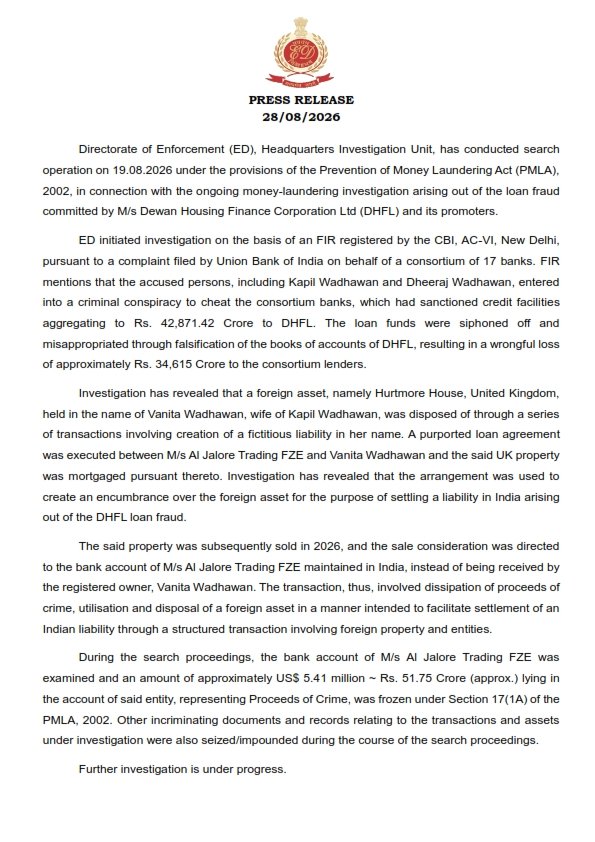
The Directorate of Enforcement’s Headquarters Investigation Unit conducted a search operation on August 19, 2026 under the Prevention of Money Laundering Act, 2002 (PMLA). The search was connected to the ongoing money-laundering probe into the loan fraud committed by DHFL and its promoters.
During the search, the bank account of M/s Al Jalore Trading FZE – a Dubai-registered trading firm – was examined. Approximately US$ 5.41 million, or about Rs 51.75 crore, was found parked in the account. The ED determined this amount represented Proceeds of Crime and froze it under Section 17(1A) of the PMLA. Other incriminating documents and records relating to the transactions and assets under investigation were also seized.
The search was based on an FIR registered by the CBI (AC-VI, New Delhi) pursuant to a complaint filed by Union Bank of India on behalf of a consortium of 17 banks.
| Detail | Value |
|---|---|
| Amount frozen | Rs 51.75 crore (US$ 5.41 million) |
| Total credit facilities sanctioned | Rs 42,871.42 crore |
| Loss to consortium lenders | Rs 34,615 crore |
| Banks defrauded | 17 banks (Union Bank led consortium) |
| Foreign asset | Hurtmore House, United Kingdom |
| Shell entity | Al Jalore Trading FZE |
| Search date | 19.08.2026 |
| FIR registered by | CBI AC-VI, New Delhi |
PMLA is the Prevention of Money Laundering Act, the law that lets agencies freeze assets suspected to be crime proceeds. Proceeds of Crime means money or property gained from illegal activity. A consortium is a group of banks that lend to one borrower together.
The UK property that is the heart of the story
Here is where the case gets interesting. Investigation revealed that a foreign asset – Hurtmore House, United Kingdom – held in the name of Vanita Wadhawan, wife of Kapil Wadhawan, was disposed of through a series of transactions involving the creation of a fictitious liability in her name.
A purported loan agreement was executed between M/s Al Jalore Trading FZE and Vanita Wadhawan, and the UK property was mortgaged under that agreement. The ED’s investigation shows the arrangement was used to create an encumbrance over the foreign asset for the purpose of settling a liability in India arising from the DHFL loan fraud. Translation: a fake loan was used to justify real money movements linked to alleged crime proceeds.
The property was then sold in 2026, and the sale consideration was directed to the bank account of Al Jalore Trading FZE maintained in India – instead of going to the registered owner. That is the shell-entity tell: a sale that pays the wrong person.
How the Rs 34,615 crore DHFL fraud worked
The FIR mentions that the accused – including Kapil Wadhawan and Dheeraj Wadhawan – entered into a criminal conspiracy to cheat the consortium banks, which had sanctioned credit facilities aggregating to Rs 42,871.42 crore to DHFL. The loan funds were siphoned off and misappropriated through falsification of the books of accounts of DHFL, causing a wrongful loss of approximately Rs 34,615 crore to the consortium lenders.
| Financial detail | Amount |
|---|---|
| Sanctioned credit facilities | Rs 42,871.42 crore |
| Loss to consortium lenders | Rs 34,615 crore |
| Amount frozen by ED | Rs 51.75 crore |
| Banks in consortium | 17 banks |
| Led bank | Union Bank of India |
Look at that gap. Rs 34,615 crore of alleged losses, and this freeze captures Rs 51.75 crore – about 0.15 percent. The math is not an accident. It is the reality of cross-border recovery: slow, layered, and far behind the money that moved. But it is also proof the investigation is still active.
The shell entity: how Al Jalore Trading FZE worked
The scheme was layered to move money across borders. Al Jalore Trading FZE, a Dubai-registered trading firm, maintained an Indian bank account. A UK property was sold, but instead of the proceeds going to the registered owner, they were directed into the Al Jalore account in India.
The mechanism was a supposedly legitimate-looking loan agreement between Al Jalore and Vanita Wadhawan. That agreement created a paper trail suggesting the property was collateral for a loan. When the property sold, the proceeds “repaid” the fictitious loan – through Al Jalore’s Indian account. That is the classic layering technique: a fake debt legitimises the movement of real money, and the shell entity fronts the trail.
The ED’s conclusion is direct: the arrangement created an encumbrance over the foreign asset to settle a liability in India arising from the DHFL loan fraud – a dissipation of proceeds of crime using a foreign asset and foreign entities in a structured transaction.
Why this matters to DHFL investors and depositors
DHFL was one of India’s largest housing finance companies before its collapse. The fraud hit bondholders, fixed deposit holders, home buyers and the consortium banks. Two years after the case exploded into public view, the search and freeze show authorities are still sifting international trails.
For investors, the honest takeaway is that recovery is real but glacial. A Rs 51.75 crore freeze against a Rs 34,615 crore loss is a breadcrumb, not a meal. But it demonstrates a pattern the ED now understands – and that pattern is what will drive the next set of freezes and attachments. For the wider picture on banking and market news this week, see the Market section on Wealth Journal Insights.
DHFL money laundering case
The August 19 search and freeze reveals how DHFL promoters allegedly tried to launder fraud proceeds – through a UK property sale, a fictitious loan and a Dubai shell entity. With Rs 34,615 crore in alleged losses to 17 banks, this remains one of India’s biggest banking frauds. The frozen Rs 51.75 crore is 0.15 percent of the loss, but it shows the investigation is still tracing international assets. Expect more attachments: investigations of this kind do not stop at the first shell.
Disclaimer: This article is for informational purposes only and does not constitute legal or investment advice. Figures are sourced from the ED press release dated August 28, 2026. The accused are presumed innocent until proven guilty in a court of law. Conduct your own research or consult a legal professional before making any decisions based on this information.