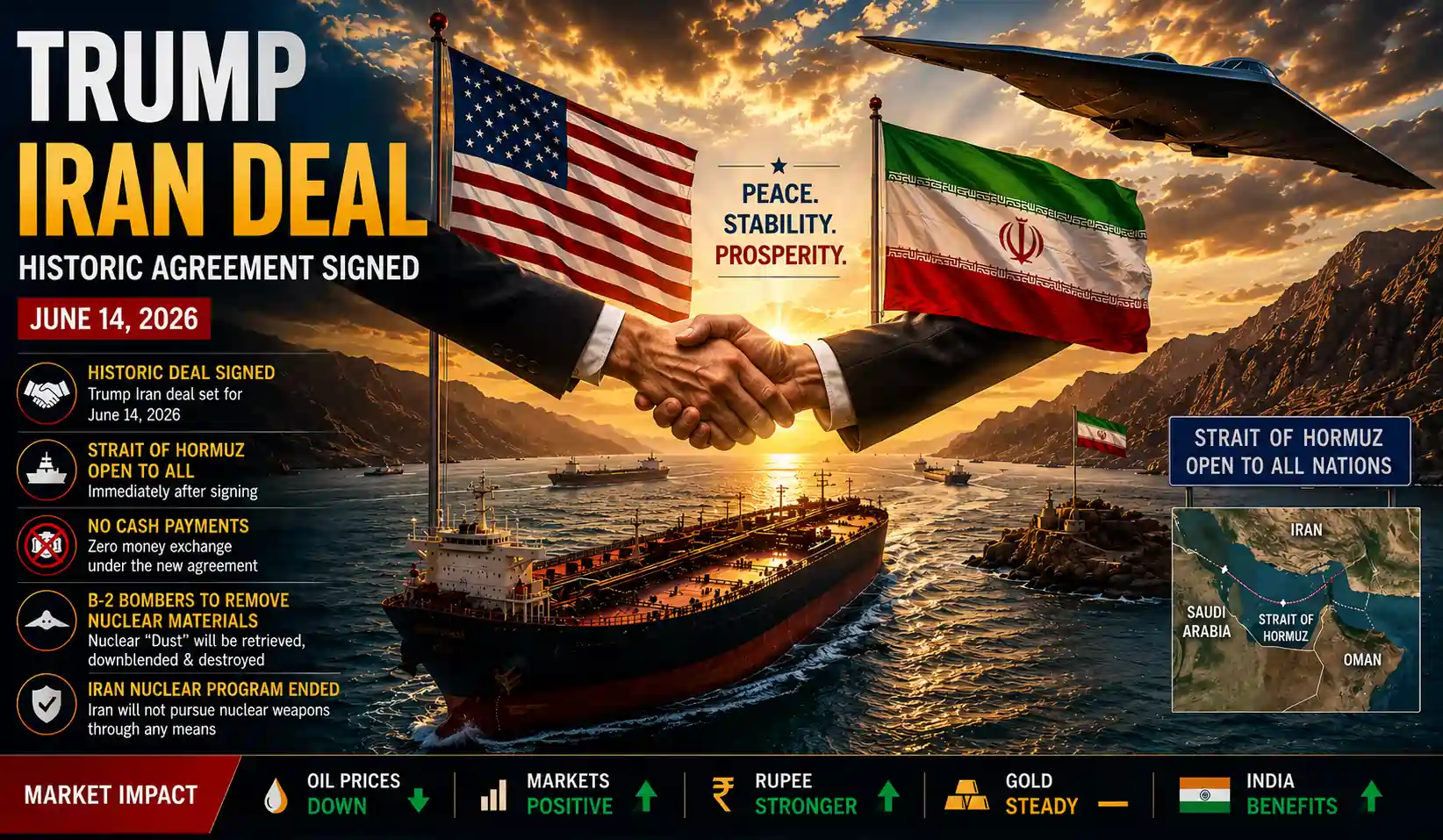
President Donald Trump has announced that the Trump Iran deal will be signed tomorrow, June 14, 2026. In a sweeping statement, Trump declared that the Strait of Hormuz will open to all nations immediately after signing, and that the “Nuclear Dust” buried under Iran’s granite mountains will be destroyed by American B-2 Bombers. Here is the complete statement and what this historic Trump Iran deal means for global markets, crude oil prices, gold, the Indian rupee, and Indian stock market investors.
Full Statement: Trump Iran Deal Announcement
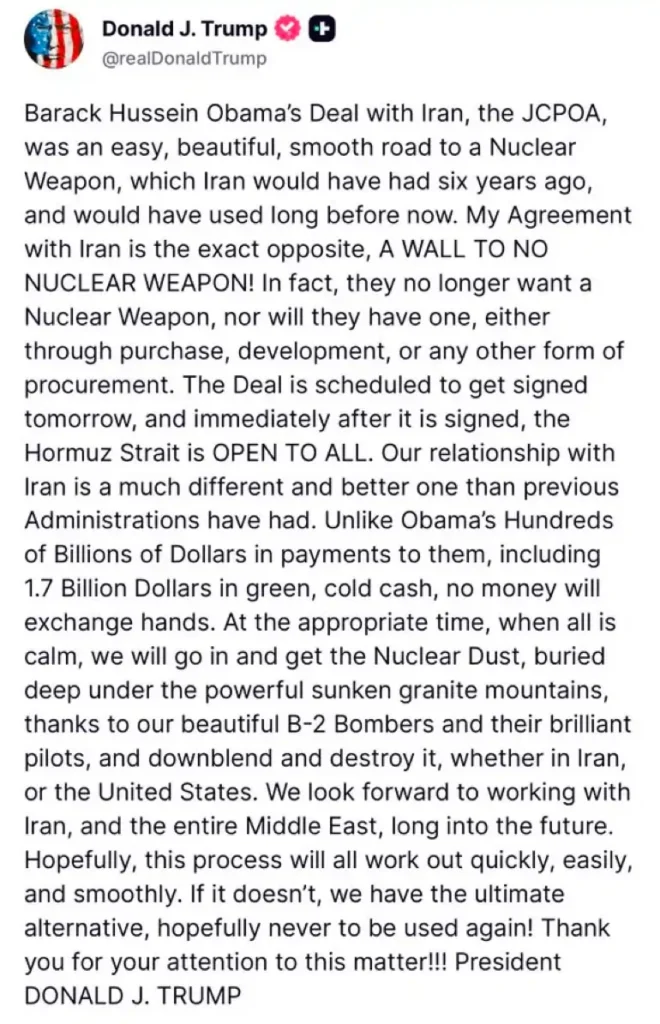
Barack Hussein Obama’s Deal with Iran, the JCPOA, was an easy, beautiful, smooth road to a Nuclear Weapon, which Iran would have had six years ago, and would have used long before now. My Agreement with Iran is the exact opposite, A WALL TO NO NUCLEAR WEAPON! In fact, they no longer want a Nuclear Weapon, nor will they have one, either through purchase, development, or any other form of procurement.
The Deal is scheduled to get signed tomorrow, and immediately after it is signed, the Hormuz Strait is OPEN TO ALL. Our relationship with Iran is a much different and better one than previous Administrations have had. Unlike Obama’s Hundreds of Billions of Dollars in payments to them, including 1.7 Billion Dollars in green, cold cash, no money will exchange hands.
At the appropriate time, when all is calm, we will go in and get the Nuclear Dust, buried deep under the powerful sunken granite mountains, thanks to our beautiful B-2 Bombers and their brilliant pilots, and downblend and destroy it, whether in Iran, or the United States.
We look forward to working with Iran, and the entire Middle East, long into the future. Hopefully, this process will all work out quickly, easily, and smoothly. If it doesn’t, we have the ultimate alternative, hopefully never to be used again!
Key Takeaways from the Trump Iran Deal
- Signing Date Confirmed: The Trump Iran deal is scheduled for June 14, 2026, marking a historic breakthrough after months of negotiations following the February 2026 US-Israel strikes on Iran.
- Strait of Hormuz Open: Immediately after signing, the strategic Strait of Hormuz is fully open to all nations, removing the biggest geopolitical risk to global oil supply.
- No Cash Payments: Unlike the Obama administration’s .7 billion cash payment, this deal involves zero money exchange.
- B-2 Bombers to Remove Nuclear Materials: US B-2 Spirit stealth bombers will enter Iran to retrieve enriched nuclear materials buried under granite mountains.
- Iran Nuclear Program Ended: Trump claims Iran no longer seeks nuclear weapons through any means of procurement.
How the Trump Iran Deal Impacts Crude Oil Prices
The Trump Iran deal is the single most important event for oil markets in 2026. The Strait of Hormuz handles roughly 20 million barrels of oil daily – one-fifth of global consumption. With the strait immediately open and Iranian oil exports set to resume, the supply risk premium that has kept prices elevated will collapse.
Brent crude could test -60 per barrel levels. For India, which imports over 85% of its crude requirements, every drop in oil prices saves approximately billion annually. This is directly positive for the Indian economy, current account deficit, and inflation outlook. Major global agencies including Reuters and Bloomberg have highlighted the magnitude of this supply shift.
Indian Rupee Outlook After the Trump Iran Deal
The Indian rupee hit an all-time low of 96.39 against the US dollar in May 2026, driven primarily by oil price shock and geopolitical uncertainty surrounding US-Iran tensions. The Trump Iran deal changes this equation entirely. Lower crude prices will reduce India’s import bill, narrow the trade deficit, and support a sharp rupee recovery. A stronger rupee benefits sectors with foreign currency debt – particularly airlines and infrastructure – but creates headwinds for IT and pharma exporters.
Gold and Silver Market Impact
The Trump Iran deal removes a significant geopolitical risk premium that has supported gold prices through early 2026. However, the relationship is nuanced. If lower oil prices lead to deflationary pressure and potential US Federal Reserve rate cuts, gold could find a floor at lower levels. MCX gold prices will also be influenced by Indian rupee movement – a stronger rupee reduces gold prices in INR terms. Silver faces additional headwinds from reduced geopolitical safe-haven buying but benefits from lower energy costs in mining and industrial processing.
Sector-Wise Impact of the Trump Iran Deal on Indian Markets
| Sector | Impact | Reason |
|---|---|---|
| Oil Marketing Companies | Strong Positive | Lower crude prices, healthier refining margins |
| Aviation | Strong Positive | Jet fuel (30-40% of costs) set to fall sharply |
| Paint, Tyre, FMCG | Positive | Crude derivatives like bitumen and rubber get cheaper |
| Gold ETFs & Jewellers | Mixed | Lower safe-haven demand but lower input costs |
| Defense & Geopolitical Plays | Negative | De-escalation reduces defense spending urgency |
| IT & Pharma Exporters | Cautious | Stronger rupee hurts USD-denominated revenue |
What the B-2 Bomber and Nuclear Dust Mean
One of the most striking aspects of the Trump Iran deal is the unprecedented provision for US B-2 Spirit stealth bombers to physically enter Iranian airspace to retrieve enriched nuclear materials – referred to as “Nuclear Dust” – buried deep under the country’s granite mountains. The material will be “downblended” (diluted to non-weapons-grade levels) and destroyed either in Iran or the United States. According to BBC News, this goes far beyond the Obama-era JCPOA’s monitoring-and-limits framework.
Strategic Importance of the Strait of Hormuz
The immediate opening of the Strait of Hormuz under the Trump Iran deal is a game-changer for global energy security. Throughout early 2026, the threat of an Iranian blockade had kept oil prices elevated, tanker insurance premiums high, and energy markets on edge. The strait’s reopening normalizes shipping routes and removes a key tail risk for global trade.
What Indian Investors Should Do
- Accumulate OMCs and aviation stocks on any dips – the structural benefit of lower crude is multi-year
- Reduce tactical gold holdings if held purely for geopolitical hedging; keep 5-10% strategic allocation
- Watch for RBI rate cuts – lower oil prices mean lower inflation, giving RBI room to cut rates
- IT and pharma exporters – a stronger rupee creates margin pressure; hedge USD exposure
- Debt markets – bond yields could fall as inflation expectations moderate
The Trump Iran deal is scheduled for signing on June 14, 2026, as confirmed by President Trump in his official statement. Trump’s statement confirms that “immediately after it is signed, the Hormuz Strait is OPEN TO ALL.” Key differences: no cash payments to Iran, physical removal of nuclear materials by US B-2 bombers, immediate opening of the Strait of Hormuz, and Trump’s characterization of his deal as a complete nuclear wall versus Obama’s deal as a “road to nuclear weapons.”
Nuclear Dust refers to enriched uranium materials buried under Iran’s granite mountains. US B-2 Spirit stealth bombers will retrieve these materials and downblend them to non-weapons-grade levels for permanent destruction.
How will this Trump Iran deal affect gold prices in India?
The geopolitical de-escalation removes safe-haven support, but potential Fed rate cuts and a weaker dollar narrative could provide a floor. A stronger rupee will also reduce MCX gold prices in INR terms.
Why the Trump Iran Deal Matters
The Trump Iran deal is the most consequential geopolitical development of 2026 for global financial markets. The immediate opening of the Strait of Hormuz reshapes oil supply dynamics, the zero-cash-payment structure marks a departure from past agreements, and the B-2 nuclear dust removal provision is unprecedented. For Indian investors, lower crude prices, a stronger rupee, and reduced geopolitical uncertainty create a favorable backdrop for equities – particularly OMCs, aviation, and rate-sensitive sectors. However, the “ultimate alternative” warning in Trump’s statement reminds us that tail risks remain. Stay updated with Wealth Journal Insights for comprehensive coverage as this historic deal unfolds.
Disclaimer: This article is for informational and educational purposes only. It does not constitute investment advice. Trading and investing involve substantial risk of loss. Always consult a SEBI-registered investment advisor before making investment decisions.