Indian Markets Slide After Budget 2026: What Went Wrong?
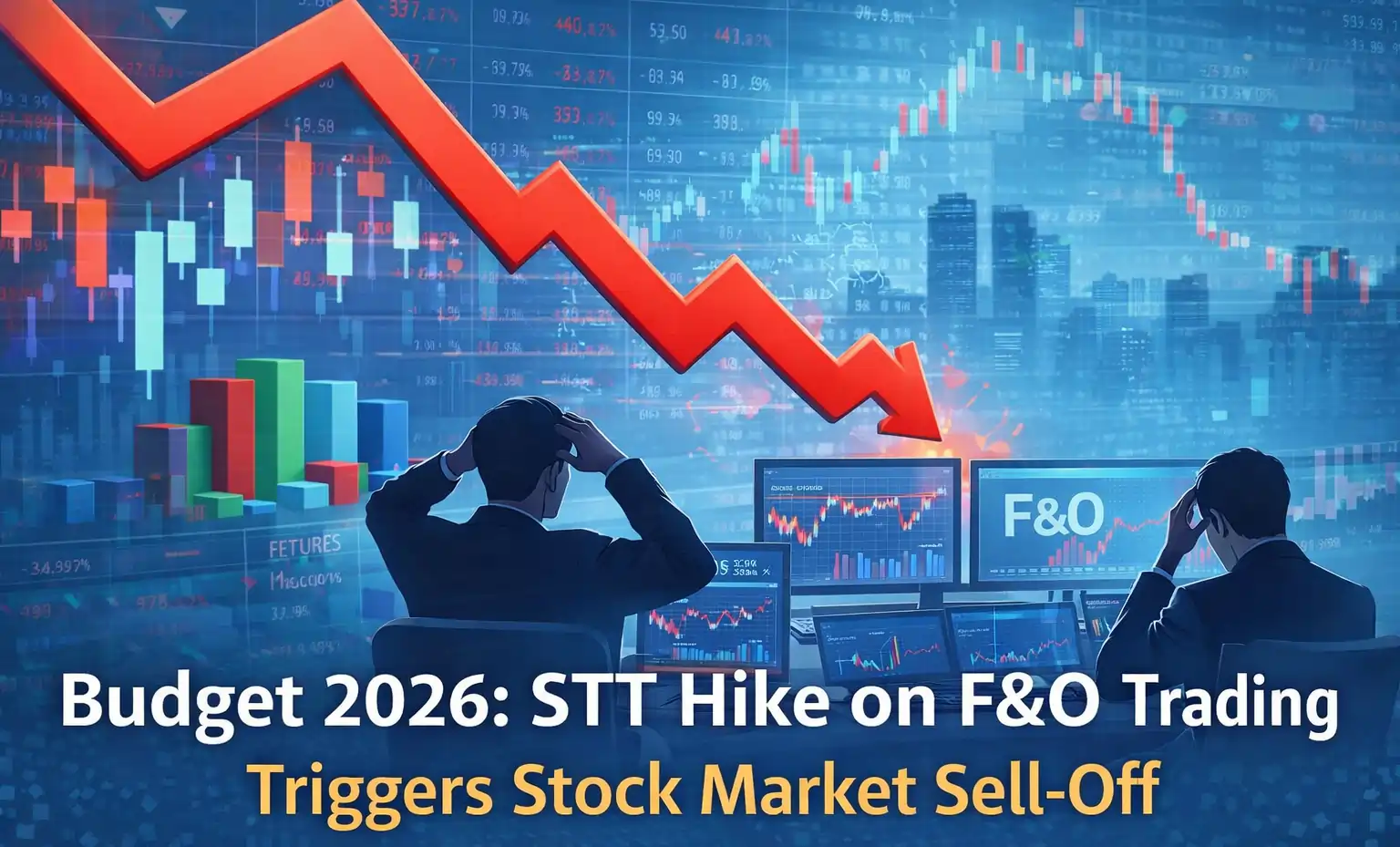
Budget 2026 has sparked a sharp sell-off in Indian equity markets, with investors reacting negatively to a steep hike in Securities Transaction Tax (STT) on Futures and Options (F&O) trading. While the government reiterated its intent to curb speculative activity, the immediate market response has been unforgiving.
Within hours of the announcement, India’s total market capitalisation eroded sharply, highlighting the growing disconnect between fiscal objectives and market sentiment.
STT Hike Explained: How Trading Just Became More Expensive
The most impactful announcement in Budget 2026 was the increase in STT on derivatives, particularly futures contracts.
Impact on Options Trading
- Average trade size ₹10,000
- STT increased from ₹10 to ₹15
- STT increased from ₹10 to ₹15
- Higher trade size ₹50,000
- STT increased from ₹50 to ₹75
- STT increased from ₹50 to ₹75
Though the percentage appears small, frequent traders will face materially higher cumulative costs.
Futures Trading Takes a Bigger Hit
- Typical futures lot size: ₹17.5 lakh
- Earlier STT: ₹350
- Revised STT: ₹875
This represents a 2.5× increase, directly impacting:
- Futures traders
- Cash–futures arbitrage strategies
- Hedging activity by institutions and high-volume traders
Why the STT Increase Matters More Than It Looks
While the tax rate increase stands at just 0.15%, its effect is magnified due to:
- High trading frequency in F&O
- Large contract values
- Razor-thin arbitrage margins
Market participants argue that ₹10,000 crore in additional tax collection has come at the cost of nearly ₹10 lakh crore in market capitalisation, at least in the short term.
Key Reasons Behind Today’s Market Fall
Multiple factors combined to deepen the sell-off:
STT Hike Focused Only on F&O
- No relief or clarity on long-term capital gains (LTCG)
- Strong message against speculative trading
PSU Banks Under Pressure
- Markets had priced in higher FII limits and value unlocking
- Absence of announcements led to profit-taking
Weak Global Sentiment on Gold and Silver
- Sharp volatility in precious metals weighed on overall sentiment
Persistent Rupee Weakness
- Continued pressure against the US dollar added to risk aversion
US–India Trade Deal Overhang
- Lack of clarity on timelines kept global investors cautious
Government’s Message Is Clear: No Incentive for Speculation
Budget 2026 sends an unambiguous signal:
Speculation and high-frequency gambling in markets will not be encouraged.
By choosing not to tweak LTCG while sharply raising STT on derivatives, the government has clearly prioritised long-term investing over leveraged trading.
What This Means for Traders and Investors
Short-Term Outlook
- Elevated volatility in derivatives
- Lower volumes in F&O segments
- Pressure on brokerage-driven stocks
Medium-Term Impact
- Reduced speculative excess
- Higher cost of hedging for institutions
- Shift toward cash-market investing
Long-Term Implication
- Structural clean-up of derivatives markets
- Stronger focus on capital formation rather than short-term churn
The Budget 2026 STT hike may improve tax revenues, but it has come at a significant cost to market confidence in the near term. While the government’s stance against speculation is now unmistakable, markets will need time to adjust to higher transaction costs—especially in the F&O ecosystem.
Whether this move leads to healthier markets or prolonged volume contraction will depend on how quickly confidence returns and whether global cues stabilise.