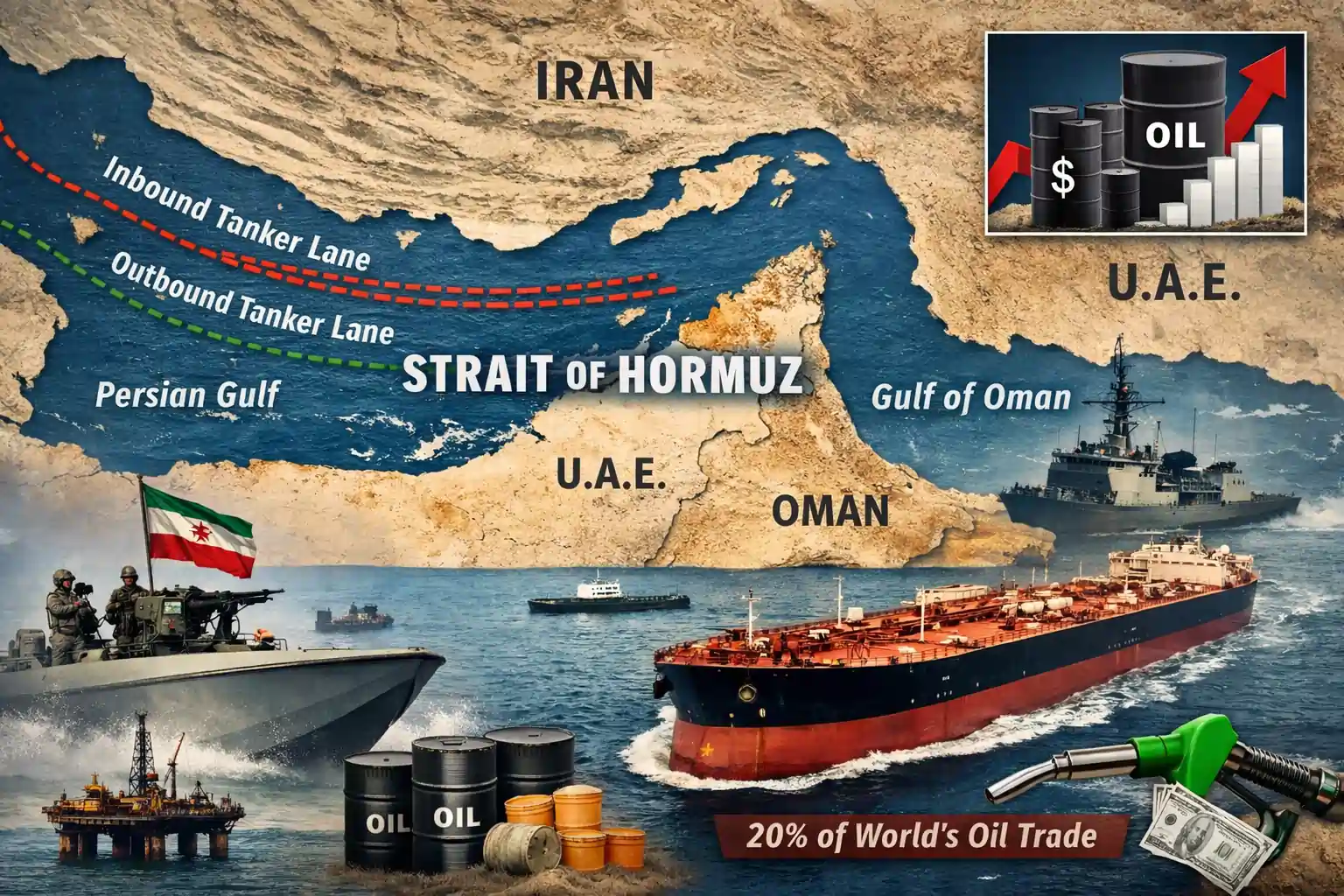
The Strait of Hormuz remains the most vital chokepoint in the global energy system, handling a massive share of the world’s oil trade through one of the narrowest and most strategically sensitive maritime corridors. As geopolitical tensions periodically rise in the Middle East, this narrow waterway continues to influence global markets, shipping costs, and economic stability especially for energy-importing nations like India.
A Narrow Passage With Global Impact
Located between Iran to the north and Oman and the United Arab Emirates to the south, the strait connects the Persian Gulf to the Gulf of Oman and the Arabian Sea.
Despite being only about 33 kilometers wide at its narrowest navigable point, it carries enormous volumes of tanker traffic through tightly controlled shipping lanes, making it one of the world’s most vulnerable supply bottlenecks.
Why It Matters to the Global Economy
Data from the US Energy Information Administration shows that roughly one-fifth of global petroleum consumption — close to 20 million barrels per day moves through the strait.
Major oil producers including Saudi Arabia, Iraq, Kuwait, Iran, and the UAE depend heavily on this route to supply international markets, with the majority of shipments destined for Asia.
Because such a large share of supply flows through a single corridor, even limited disruptions can quickly push oil prices higher and increase volatility in global financial markets.
Strategic and Security Importance
Given its critical role, the waterway is closely monitored by international naval forces, including the United States Navy, to ensure freedom of navigation and protect commercial shipping.
Any escalation involving regional powers has immediate implications for maritime security, insurance costs, and global energy confidence.
Why the Strait Is Crucial for India
For India, the Strait of Hormuz is central to energy security. A substantial share of crude imports from Saudi Arabia, Iraq, and the United Arab Emirates travels through this route.
Any prolonged disruption could lead to higher fuel costs, inflationary pressures, and broader economic impacts.
The Risk Scenario
Energy analysts warn that a major disruption or blockade could trigger:
- Sharp spikes in oil prices
- Supply shortages across Asia
- Higher shipping and insurance costs
- Increased geopolitical tensions
While a full closure is considered unlikely due to global economic consequences, the strait remains one of the most closely watched geopolitical flashpoints.
The Strait of Hormuz is far more than a geographic passage it is a cornerstone of global energy logistics. Its stability is essential for oil markets, economic growth, and geopolitical balance, ensuring that developments in this narrow corridor will continue to shape the global economy.
This website was… how do I say it? Relevant!!
Finally I’ve found something which helped me.
Many thanks!