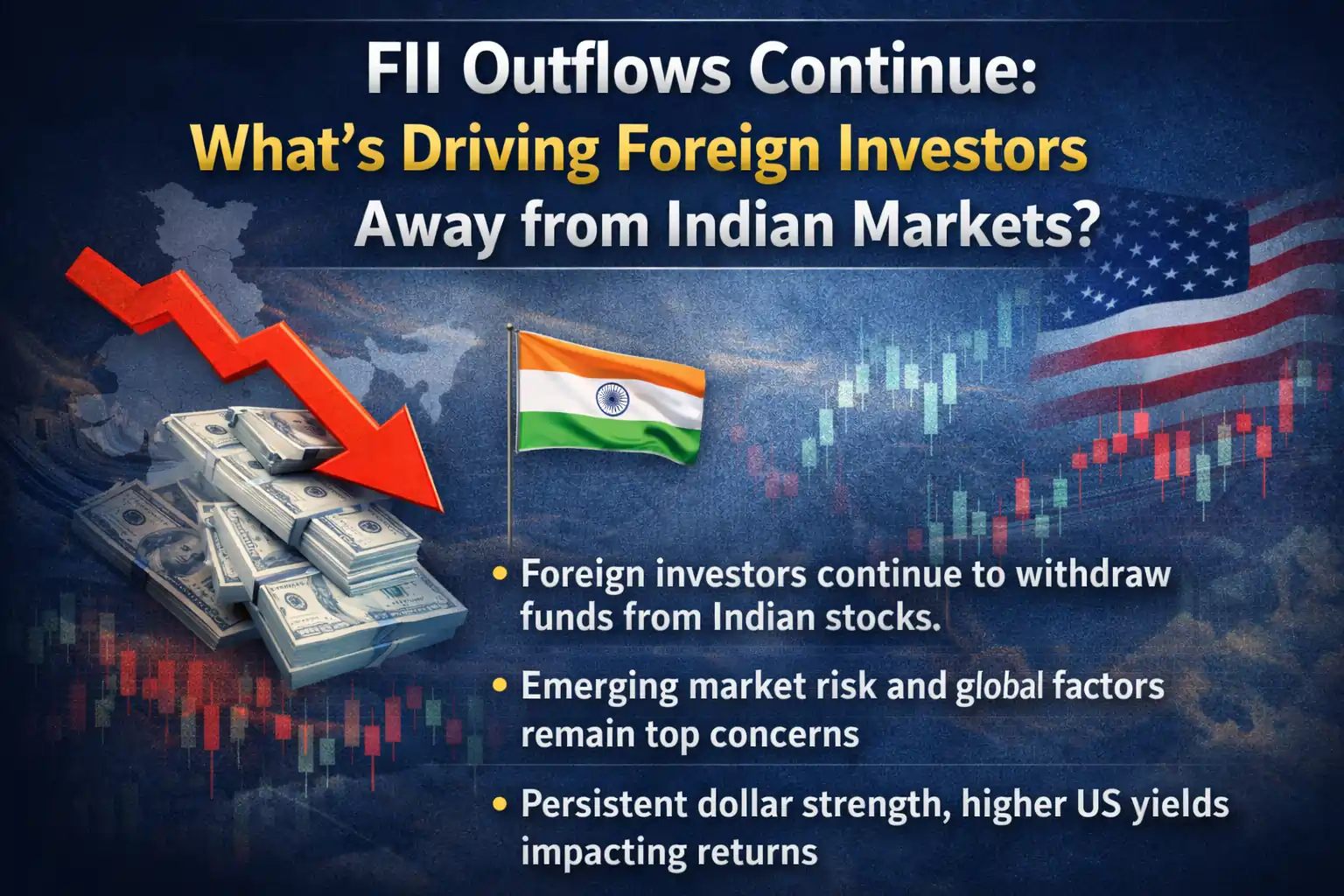
Indian equity markets have been volatile in early 2026, with sharp index swings, broad institutional selling, and defensive positioning from domestic investors. The key questions for investors today are: Is this a normal market correction, or the early sign of a deeper downturn? What are FII and DII flows signaling? How does Budget season influence sentiment? And what can investors expect in the coming month?
This article uses live institutional flow data and recent market trends to answer those questions objectively and with context.
Correction, Bear Market, Crash — What It Means Today
Before diving into data, it’s important to clearly define the common market phases:
- Market Correction: A 10–20% decline from recent highs, often triggered by profit booking or global risk events, but typically short-lived.
- Bear Market: A 20%+ decline sustained over time, usually underpinned by weak economic data or earnings contractions.
- Market Crash: A sudden, steep drop occurring in very short periods, often linked to systemic shocks.
At present, despite significant selling pressure, current declines still resemble a correction rather than a structural bear market — and live FII–DII data reinforces that interpretation.
FII–DII Flows: Who’s Selling, Who’s Supporting?
Foreign Institutional Investors (FIIs) — Persistent Selling
Recent data shows that FIIs have been net sellers in Indian equities:
- On 20 Jan 2026, FIIs were net sellers of about ₹2,938 crore in the cash segment.
- For the last 7 days, FIIs continued net selling to the tune of over ₹10,000 crore, pointing to ongoing foreign risk aversion.
- Monthly figures confirm FIIs have been net sellers of over ₹53,000 crore in the past 30 days.
This aligns with broader market commentary that global investors are cautious about emerging market equities due to interest rate uncertainty, geopolitical tensions, and currency volatility.
Historic trends also show that FIIs have been strong sellers in January for many years. According to a decade-long review, FIIs were net sellers in January in 7 out of the last 10 years, often weighing on early-year performance.
FII selling has materially impacted headline markets: in a recent session on 21 Jan 2026, the Sensex fell over 650 points and the Nifty dipped below 25,100, driven in part by foreign selling pressure.
Domestic Institutional Investors (DIIs) — Steady Support
DIIs have largely offset FII selling through consistent buying:
- On the same trading session (20 Jan), DIIs were net buyers of around ₹3,665 crore.
- Broader flow trends show that DIIs continue to purchase equities even as FIIs sell, reflecting sustained domestic confidence.
The resilience shown by DIIs is part of a long-term structural shift in the market:
- In 2025, DIIs pumped in an exceptionally high amount — over ₹4 lakh crore in the first seven months, the highest since 2007 — cushioning markets amid heavy foreign selling.
This divergence between FIIs and DIIs suggests that domestic capital remains committed to Indian equities, even when global funds are reducing exposure.
Budget Season: What to Expect Before and After
Pre-Budget Behaviour
Before key policy events such as the Union Budget, markets typically:
- Experience heightened volatility due to speculation
- See sector rotation as funds position for possible policy outcomes
Domestic investors tend to hold firm or even buy on dips, while foreign funds may reduce risk ahead of uncertainty.
This pattern has appeared in recent sessions, with FIIs selling but DIIs and retail flows remaining active.
Post-Budget Trends
Following the Budget announcement:
- Markets often shift focus from speculation to execution and earnings
- Initial reactions may reverse as details are digested
- Sector performance usually depends on policy impact (e.g., infrastructure, capital goods)
Historical data show that markets can stabilize post-Budget if corporate earnings and liquidity conditions remain benign.
How This Compares With a Bear Market or Crash
A true bear market generally requires:
- Cascading sell-offs across sectors
- Earnings downgrades
- Weak macro data
- Structural liquidity stress
While current selling is broad and FII-driven, corporate earnings and domestic liquidity have not collapsed, and DIIs continue buying.
A crash, in contrast, is typically associated with a sudden shock and extreme volatility — conditions that are not yet evident in the Indian context.
What Next? Market Outlook for the Coming Month
Based on the latest data and flows, here’s a near-term interpretation:
1. Volatility May Persist
Continuing FII outflows will likely exert pressure on daily index movements, especially in large caps where foreign participation is high.
2. DIIs Provide a Buffer
Strong domestic institutional purchases often act as a shock absorber, preventing sharp crashes even during foreign selling phases.
3. Sector Leadership May Shift
Under pressure from broader selling, sectors with weaker earnings or higher valuations may underperform, while defensive sectors and fundamentally strong stocks could attract targeted interest.
Conclusion: Correction, Not Collapse
Current market behavior — driven by FII selling, DII support, and event-driven volatility — resembles a correction more than a structural bear market or crash. Institutional flows indicate caution from foreign investors, but strong domestic participation continues to support valuations.
For the coming month, markets may remain range-bound and sensitive to global macro cues, earnings updates, and policy signals. Disciplined investors who understand institutional flow dynamics and macro trends will be better positioned to navigate this phase.