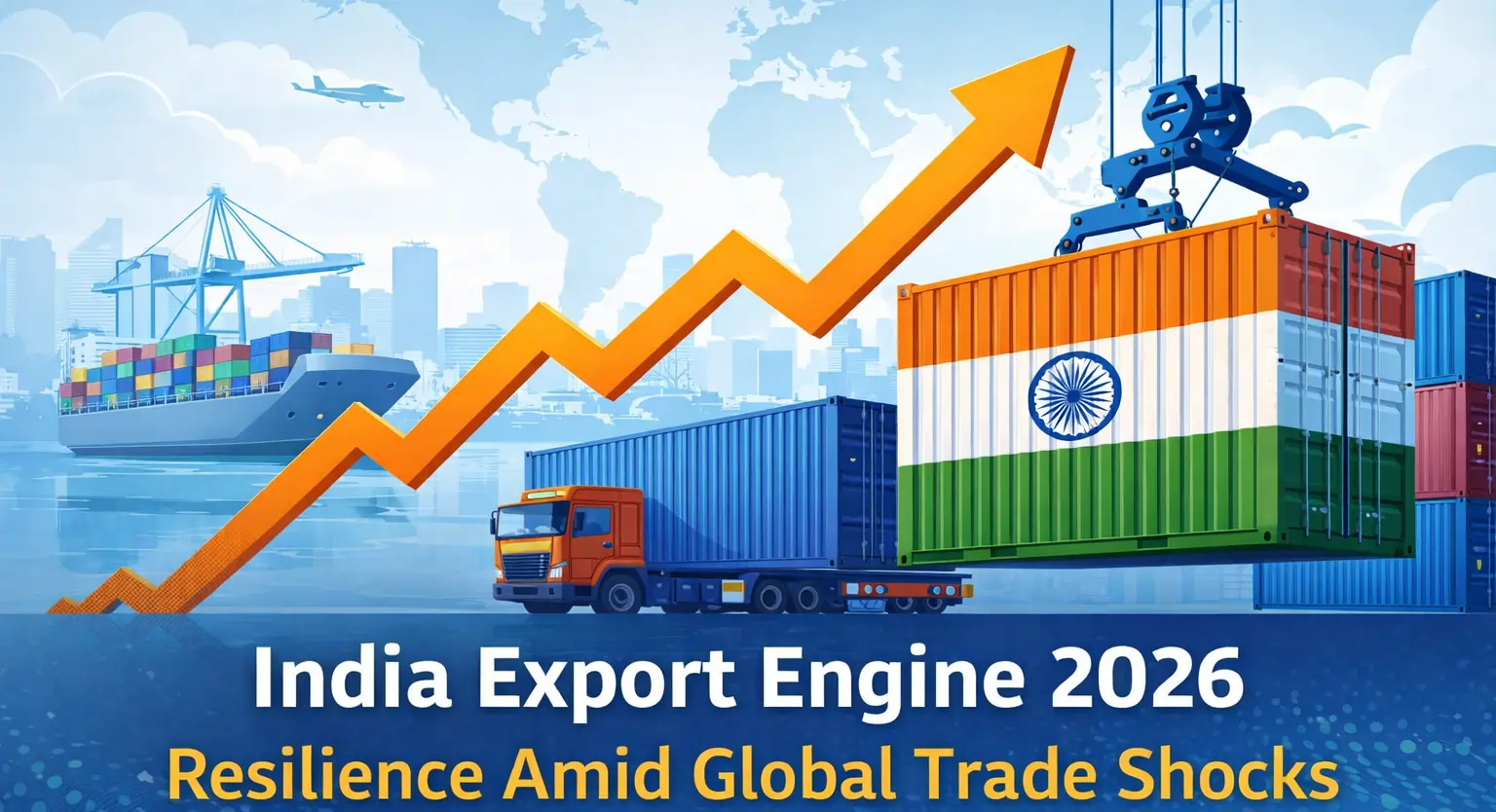
ndia’s export ecosystem is poised for further acceleration in 2026, demonstrating remarkable resilience against persistent global trade headwinds, tariff pressures, and shifting supply-chain dynamics. While external conditions remain uneven, a combination of record export performance, diversified trade relationships, and structural reforms is underpinning optimism among policymakers and industry stakeholders.
Record Exports and Sustained Momentum
According to the Economic Survey 2026, India’s external sector has posted all-time export highs, signaling strong underlying momentum.
- Total exports (goods and services) touched a record $825.3 billion in FY25, showcasing sustained external demand.
- In the first half of FY26, exports remained resilient at $418.5 billion, driven by services, electronics, pharmaceuticals, and engineering products.
Despite elevated tariff barriers and slowing global trade growth, merchandise and services exports have continued to grow, underscoring India’s ability to navigate global volatility.
Navigating Global Headwinds
Tariff Pressures and Trade Disruption
India’s export expansion has endured even as major markets increased tariffs on select goods. Higher US tariff rates introduced in 2025 prompted concerns over exports to America, India’s largest export destination. However, exports to the US rebounded in late 2025, highlighting exporter adaptability and strategic pricing adjustments.
At the same time, slowing global demand and recessions in major economies have dampened overall trade growth, with the World Trade Organization projecting slower expansion in 2026.
Diversified Growth Drivers
India’s export performance is no longer tied to a narrow set of markets or products. Key contributors include:
- Services exports: Software services, business services, and Global Capability Centres continue to anchor export receipts.
- Manufactured goods: Electronics, pharmaceuticals, and electrical machinery have recorded strong growth, supported by production-linked incentive schemes and FDI inflows.
- New market access: Negotiations and agreements with multiple partners are opening fresh opportunities beyond traditional markets.
Free Trade Agreements Expand Market Access
One of the most transformative developments for India’s export prospects in 2026 is the acceleration of trade negotiations and agreements:
- India has concluded or accelerated free trade talks with several key partners, expanding preferential market access for exporters.
- Recently finalized agreements — including a landmark pact with the European Union — are expected to significantly reduce tariffs and enhance export potential across sectors.
- Other FTAs with countries like the UK, Oman, and New Zealand are progressing and set to take effect in the coming year, diversifying India’s trade network and reducing dependence on a few major markets.
This broadening of trade partnerships is helping Indian exporters hedge against concentrated tariff risks and shifting global trade patterns.
Structural Resilience and Policy Support
Several structural features have helped India absorb global shocks and sustain export growth:
1. Services-Led Export Surplus
Services exports have continued to outperform merchandise shipments, cushioning trade balances and supporting the current account.
2. Export Incentives and Credit Support
Government programmes aimed at export promotion — including export credit support, longer financing tenors, and debt moratoriums — have strengthened the competitive position of exporters.
3. Supply-Chain Integration
Integration into global value chains, particularly for electronics and pharmaceuticals, has enabled Indian firms to diversify both products and destinations.
Outlook for 2026
While global economic growth forecasts have been revised downward due to trade tensions and policy uncertainty, India’s export engine is positioned to sustain momentum and capture emerging opportunities:
- Continued diversification into high-growth sectors
- Expansion of trade agreements
- Strengthened services export base
- Deeper integration with global value chains
These factors suggest that India export engine 2026 is transitioning from resilience to accelerated global engagement, even as macro risks persist.
India’s export performance is defying global trade shocks and protectionist pressures, achieving record highs and retaining growth momentum into 2026. With strategic policy support, expanding free trade access, and diversified export baskets, the India export engine 2026 stands on a firmer footing than many peers in a turbulent global landscape.